
By By Morgan Flood, Policy Research Specialist
Education provides a strong foundation for economic success. Recent data from the Bureau of Labor Statistics shows that increased educational attainment is associated with both higher household income and lower unemployment rate. Since income is one of the main drivers of food insecurity, this implies that robust access to high-quality, affordable education can help shield individuals and families from hunger. Furthermore, a study from the Center for Disease Control and Prevention showed that as of 2021, working adults who lived in food insecure households were less likely to have a bachelor’s degree than similar adults whose households did not face food insecurity.
In this policy blog, CPFB Impact and Policy Research (IPR) assesses educational attainment among central Pennsylvanian food pantry visitors as compared to the overall population as measured by the results of the Feeding America Client Survey (FACS) and the 2024 5-Year American Community Survey (ACS) conducted by the United States Census Bureau.
Overall, food pantry visitors in the counties where surveys asked about education were more likely than the general population in these counties to have not completed high school or to have only a high school degree or GED. Correspondingly, pantry visitors were also less likely than the overall population to have attained a bachelor’s degree or higher.
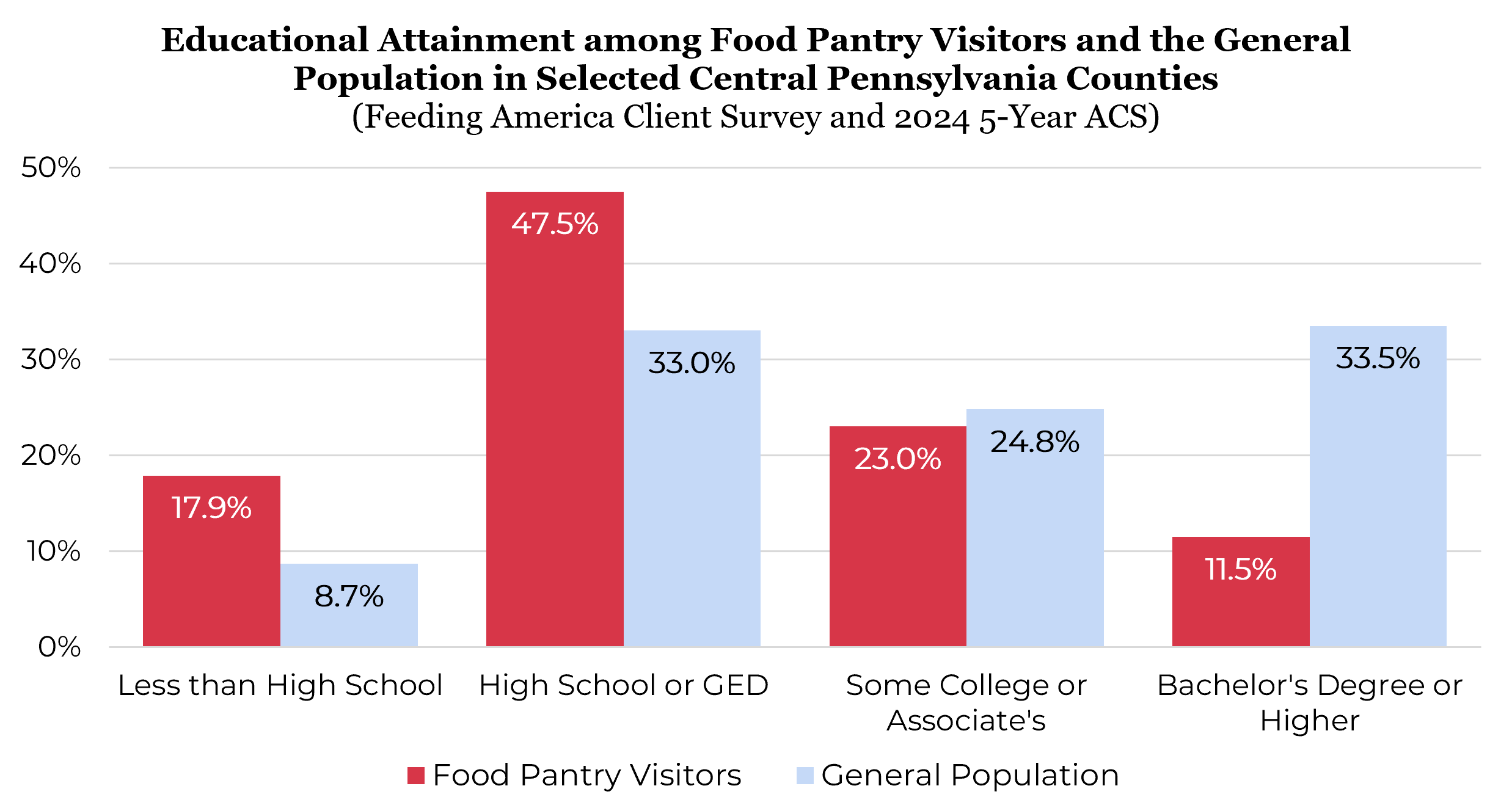
Specifically, pantry visitors were twice as likely to have not graduated high school. About one in six (17.9%) of pantry visitors lacked a high school degree, while the same was true of just one in eleven (8.7%) members of the general public. Pantry visitors were about 50% more likely to be high school graduates or hold a GED, as about half (47.5%) had high school or GED as their highest completed degree compared to about a third (33.0%) of the total population. Pantry visitors were also more than 60% less likely to have a four-year degree or more; one in nine (11.5%) pantry visitors had a bachelor’s degree or higher compared to more than a third (33.5%) of all residents of the surveyed counties.
In light of these findings, and as part of its efforts to address issues that are upstream of food insecurity, the charitable food system should be aware that education may be a barrier to economic stability for some of the individuals it serves, especially those who have not completed high school or attained a GED. Pantries could partner with local community colleges and other organizations that offer GED preparation courses, such as Pennsylvania CareerLink, to help connect interested neighbors to additional educational resources.
Data Sources and Methods:
CPFB IPR uses the Feeding America Client Survey (FACS) as the main primary data collection tool for its flagship Community Hunger Mapping initiative, which began in fall 2022. The survey instrument asks neighbors several questions about their personal circumstances, household composition, experiences at food pantries, and more, and have historically included questions about the respondent’s educational attainment. Though IPR discontinued asking about educational attainment in 2025, data on this topic was still collected in nine central Pennsylvania counties; 3,073 pantry visitor households are represented in the results. The included counties are Adams, Cumberland, Dauphin, Franklin, Lancaster, Lebanon, Northumberland, Snyder, and Union. These counties together account for just over half (54.0%) of the total population of the CPFB’s service territory, so they are fairly representative of pantry visitors across the region. For the purposes of this blog post, “don’t know” or “prefer not to answer” and blank responses were excluded, bringing the total number of households included in the analysis to 3,004. The primary data collected in FACS was then compared to 2024 5-Year American Community Survey estimates for educational attainment in the same counties.