
By Morgan Flood, Policy Research Specialist
Housing is the largest expense for most households, meaning that an individual or household’s living situation can have a major impact on experiences of economic instability, including food insecurity. According to the United States Census Bureau’s American Housing Survey, one in eight (12.7%) renter households in Pennsylvania experienced food insecurity as of 2019, the most recent year in which food insecurity questions were included in the survey. For homeowners, food insecurity rates were lower, at one in twelve (7.5%). Renters were also more vulnerable to very low food security, the most severe form of food insecurity; around one in twenty Pennsylvanian renters (5.5%) had cut the size of their meals, skipped meals, or gone hungry compared to just one in a hundred homeowners (1.2%) as of 2019.
In this policy blog, Central Pennsylvania Food Bank Impact and Policy Research (IPR) assesses housing tenure, meaning the financial and legal situation under which someone lives in a housing unit (i.e. homeownership, rentership, or other arrangement) among central Pennsylvania food pantry visitors as measured by responses to neighbor surveys and as compared to housing data from the 2024 5-Year American Community Survey (ACS).
As an integral piece of its ongoing Community Hunger Mapping research initiative, IPR conducts surveys with food pantry visitors that ask several questions about their experiences with the charitable food system, demographics, and personal circumstances, including their housing situation. To date, over 3,700 surveys have been completed at more than 70 agencies across sixteen counties since the project began in fall 2022. The sixteen represented counties are Adams, Bradford, Centre, Clinton, Cumberland, Dauphin, Franklin, Lancaster, Lebanon, Lycoming, Northumberland, Potter, Snyder, Sullivan, Tioga, and Union. Altogether, these geographically diverse counties account for more than two thirds (68.7%) of the population of CPFB’s service territory, so the survey results can be assumed to be broadly representative of food pantry visitors throughout central Pennsylvania.
As shown in the chart at right, more than half (55.9%) of central Pennsylvanian pantry visitors were renters, compared to less than a third (30.0%) of the overall population. Pantry visitors were correspondingly much less likely to be homeowners than the average central Pennsylvanian, with about a third (34.8%) owning their home compared to seven in ten among the overall population (70.0%).
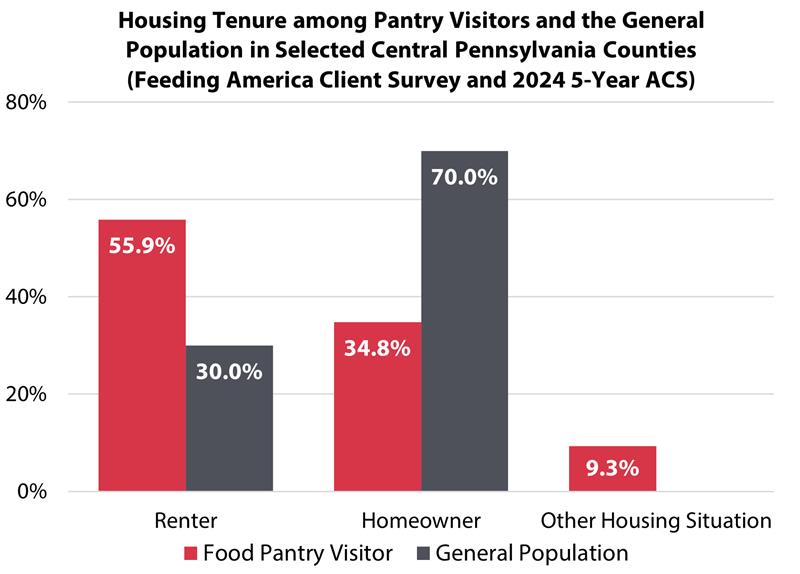
Pantry surveys asked about housing in a more granular fashion than the ACS, allowing IPR to assess the proportion of pantry visitors who are in other housing situations, including having temporary arrangements with family members or friends, living in shelters, or experiencing homelessness. One in eleven (9.2%) pantry visitors fell into this category.
These findings show that pantry visitors are much more likely than the general population to be renters, meaning that they may be more prone to experiencing sudden housing cost increases, maintenance issues, or other housing-related challenges that more commonly affect renters and that can then cause or worsen food insecurity. Additionally, a significant minority of pantry visitors are in unstable or tenuous housing situations or may be unhoused. Pantries and other stakeholders in the charitable food system should keep this in mind and make efforts to ensure they can support neighbors in difficult housing situations, including by offering foods that work well for individuals with limited cooking facilities, as well as by connecting neighbors in need of assistance to existing housing resources such as rental assistance, legal aid, eviction prevention services, and shelters or other supports for unhoused individuals.