By By Morgan Flood, Policy Research Specialist
Food insecurity is a major burden upon every person who must shoulder it, but it weighs especially heavy on children. Children who grow up in food insecure households are vulnerable to a variety of negative effects, including nutritional and health challenges, behavioral difficulties and decreased academic achievement. Some of these effects follow children for their whole lives; children who have reduced educational attainment subsequently have poorer career prospects.
Clearly, child food insecurity is a serious issue, and it is necessary to have high-quality data about who, and where, is affected so that the problem can be addressed. In the past, this role has been primarily filled by the annual USDA Household Food Security in the United States report and analyses built upon this critical resource, such as Feeding America’s Map the Meal Gap estimates.
However, as has been previously discussed on this blog, the USDA report was cancelled in 2025, leaving a void in the data and making other sources of information around the extent of food insecurity among adults and children alike extremely important. In this policy blog, CPFB Impact and Policy Research analyzes food insecurity data from the Pennsylvania Youth Survey (PAYS), a survey of public school students across the Commonwealth conducted by the Pennsylvania Commission on Crime and Delinquency with support from the Pennsylvania Department of Drug and Alcohol Programs and the Pennsylvania Department of Education.
PAYS is administered to public school students across the Commonwealth of Pennsylvania every other year. It gives 6th, 8th, 10th, and 12th graders the opportunity to respond anonymously to a variety of questions about social and behavioral topics and the school environment, including risk factors as well as protective factors. Specific topics addressed in PAYS include but are not limited to drug and alcohol use, bullying and violence, screen time, extracurricular participation, and stressful events, including housing and food insecurity. As of 2025, nearly 1,900 schools across more than 440 of Pennsylvania’s 500 total school districts participated in PAYS.
PAYS considers food insecurity by asking two questions that roughly approximate the USDA categories of low food security and very low food security respectively by asking students how often they had “worried that food at home would run out before [their] family got money to buy more” and “skipped a meal because [their] family didn’t have enough money to buy food” in the last year. The chart at right shows the statewide results for these questions over the last four survey years, ranging from 2019 to 2025.
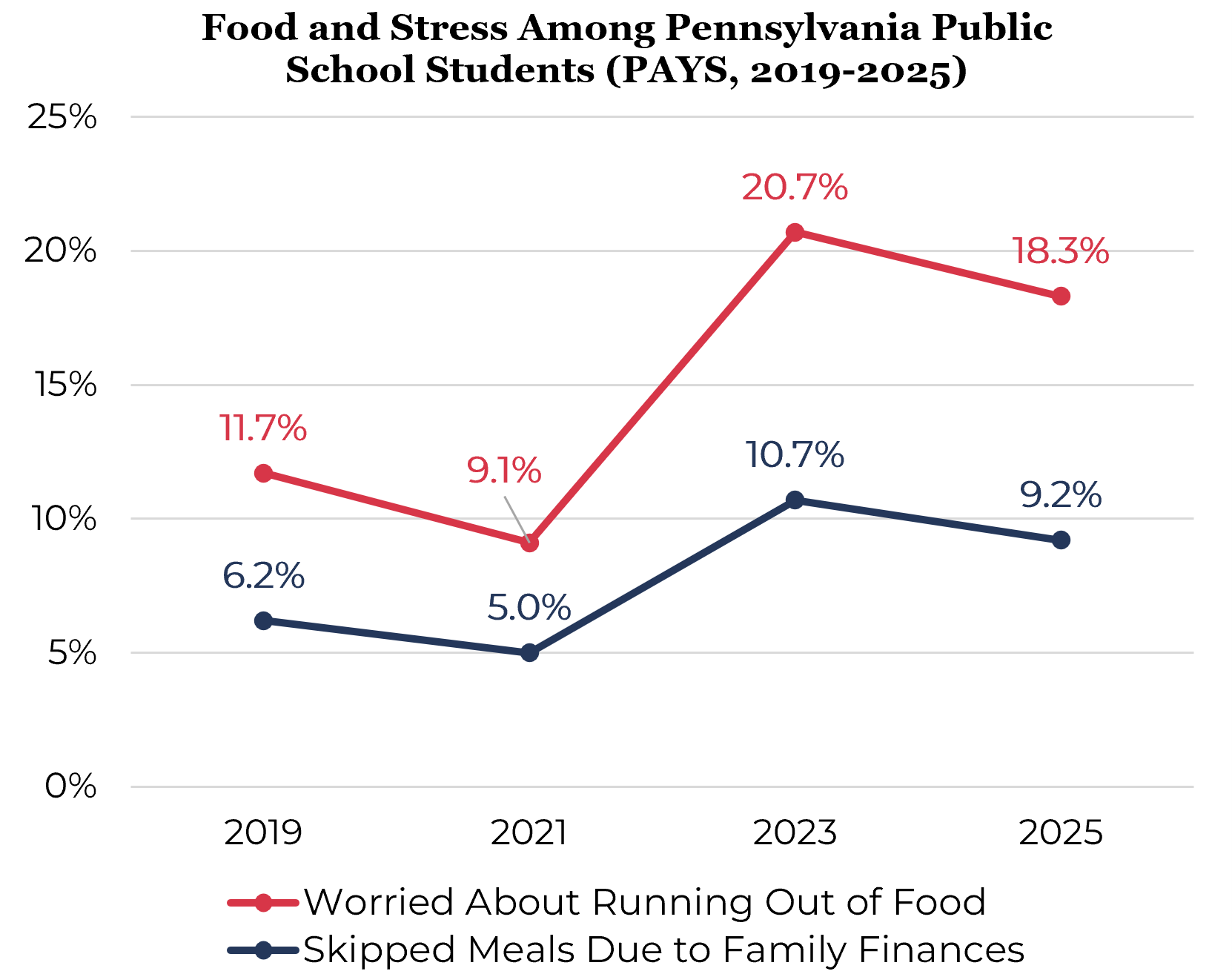
As of 2025, about one in five (18.3%) Pennsylvania students worried about running out of food and one in ten had skipped a meal in the prior year due to family financial hardship. These rates were slightly lower than those observed in 2023, but about twice those of 2021, which were 9.1% and 5.0% respectively.
The trends displayed in the PAYS data align well with those observed in other sources of child food insecurity data. 2021’s low rates of food hardship among Pennsylvania students were primarily driven by strong government response to the COVID-19 pandemic. The most important program was the expanded Child Tax Credit (CTC), which provided additional financial support to low income families with children and halved child poverty, but other programs like universal school meals likely played a role. By 2023, these programs had expired, and households were hit by price inflation around groceries and other basic needs, driving rates up. 2025’s PAYS results show some improvement but nevertheless remain well above 2021, and even the pre-pandemic year of 2019, showing the tremendous effect federal policy can have on the lives of children.
PAYS data can also be sliced by county, showing the uneven impact of food insecurity on the Commonwealth’s children by locale. County-level rates of student worry about running out of food as of 2025 ranged from a low of 10.5% in Chester County to a high of 29.3% in Luzerne County, though it is important to note that data was not available for Cameron, Forest, Juniata, Montour, Sullivan, Warren, and Wyoming counties. Additionally, in Philadelphia, the only schools that participated in PAYS were charter schools, meaning that the majority of students in the city were not surveyed because the School District of Philadelphia did not participate.
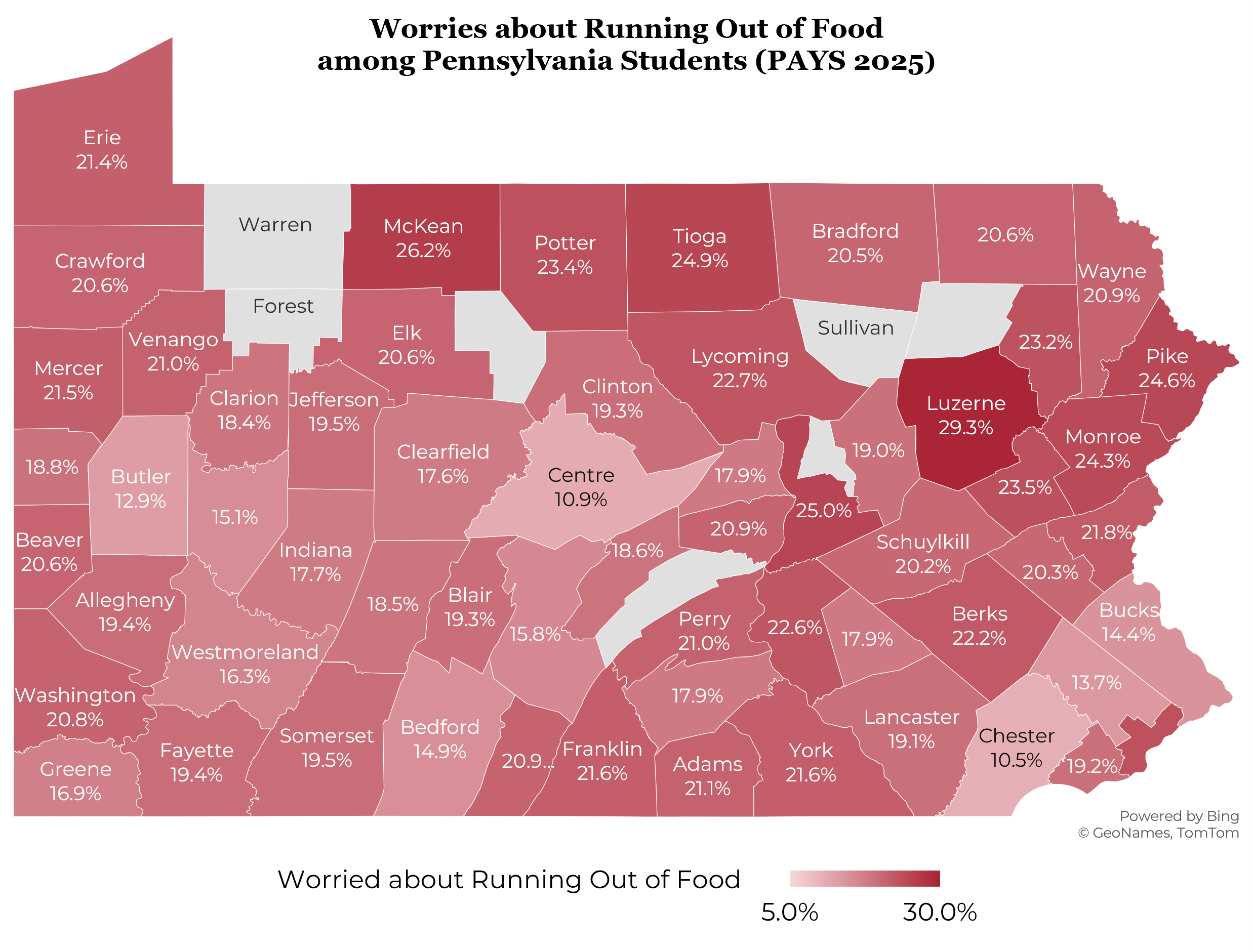
As shown in the map above, the Philadelphia collar counties (Bucks, Chester, Delaware, and Montgomery) and Butler County north of Pittsburgh tended to have the lowest rates, though Centre County also had a notably low rate of worry about food running out at 10.9%, which likely relates to the impact Penn State University has on the local economy. On the other hand, high rates were often found in either highly rural or mostly urban counties, though rates were consistently high regardless of geography; Scranton/Wilkes-Barre lies in Luzerne County, but the next highest was in McKean County (26.2%), followed by Northumberland (25.0%), Tioga (24.9%), Pike (24.6%), and Monroe (24.3%).
The share of Pennsylvania students who skipped meals due to family financial difficulties was about half that of those who worried about running out of food in most counties. County-level rates ranged from a low of 5.0% in Chester County to a high of 14.2% in Luzerne County, not including the counties for which data is unavailable.
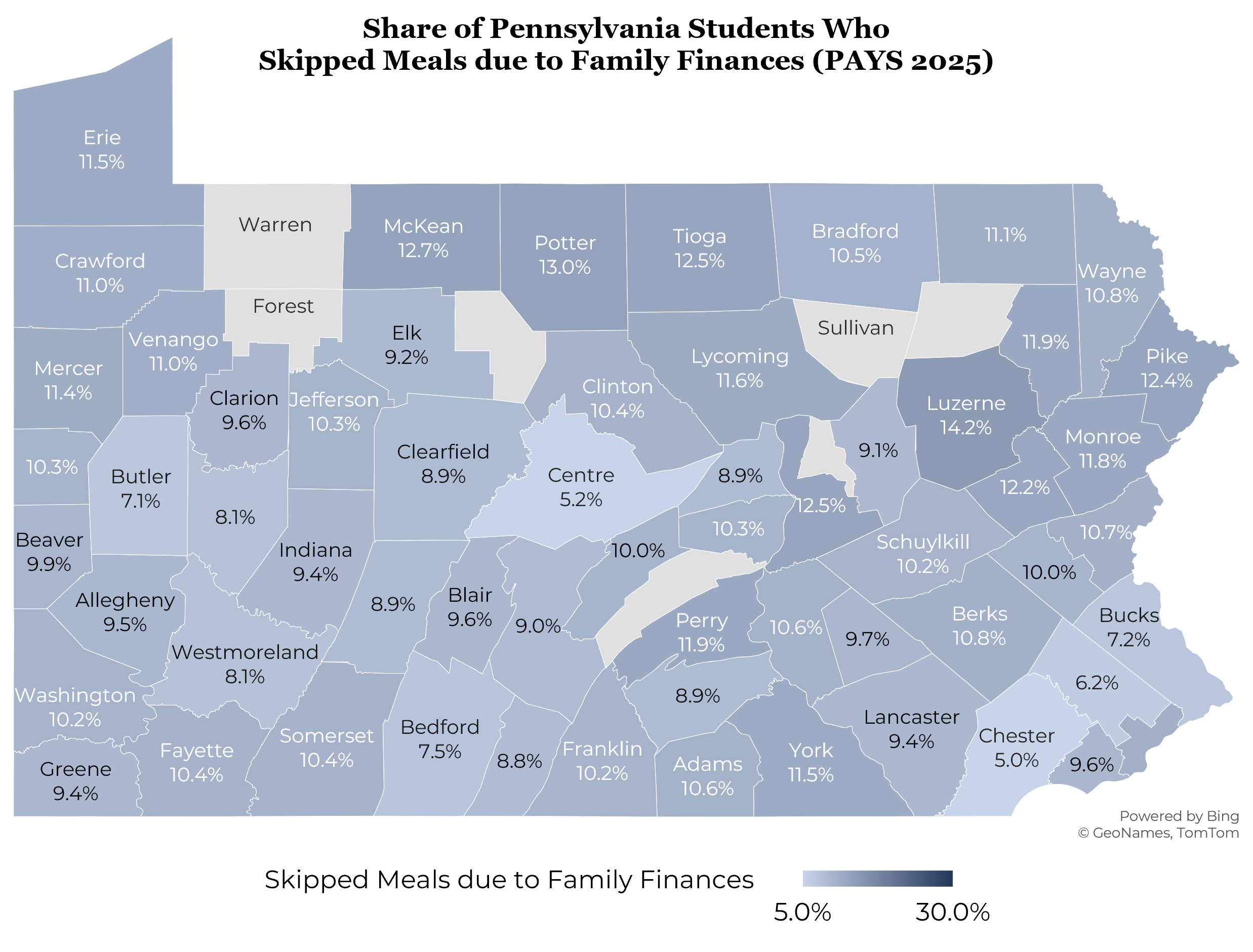
Similar to rates of worry about running out of food, skipping meals due to lack of money was least prevalent in the Philadelphia collar counties and Butler County, which all had rates of 7.2% or less. Centre County again had low rates, at 5.2%. High rates of having skipped meals continued to be found in either rural or urban counties, with Luzerne, Potter, McKean, Tioga, Northumberland, Pike, and Carbon all having rates above 12% as of 2025.
To learn more about PAYS results for the Commonwealth, for rural and urban Pennsylvania, or a specific county or grade, please see the official PAYS website.