SNAP Participation in Central Pennsylvania Over Time
By: Morgan Flood, Policy Research Specialist
By Morgan Flood, Policy Research Specialist
In July 2025, Congress passed and the President signed a major budget reconciliation bill, commonly known as the One Big Beautiful Bill Act (OBBA) into law. Some of the many provisions of this law included substantial cuts and program changes to SNAP, a critical nutrition program that provides nine meals for each one provided by the Feeding America network. Program changes to SNAP included in the 2025 budget reconciliation bill included a three-month benefit time limit for adults aged 55-64 and parents and caregivers of children aged 14 or older who do not work or volunteer at least 80 hours per month; elimination of work-requirement exemptions for veterans, former foster youth, unhoused individuals, and those living in areas with persistent high unemployment; reductions in eligibility for lawfully present non-citizens; and a significant cost-shift onto state governments.
The new work requirements went into effect in Pennsylvania beginning September 1, 2025, for individuals aged 18 to 54 without children, with an expansion to include individuals age 55 to 64 and caregivers of children aged 14 or older starting November 1, 2025. This means the impact of the first tranche of work requirements were not binding until December 2025 and the second will not be observable until February 2026, as the three-month time limit begins to be applied to households who do not meet work requirements. However, the news of changes around SNAP appears to already be affecting SNAP participation in central Pennsylvania through chilling effects and anticipated ineligibility.
As shown in the graph below, SNAP participation dropped 8.5% between December 2024 and December 2025 in the CPFB's service territory, meaning that more than 30,000 fewer central Pennsylvanians were receiving benefits in 2025 than in the year prior. For context, over the previous year, SNAP participation changed just 1.2%, rising slightly from 403,143 individuals in December 2023 to 407,820 individuals in December 2024.
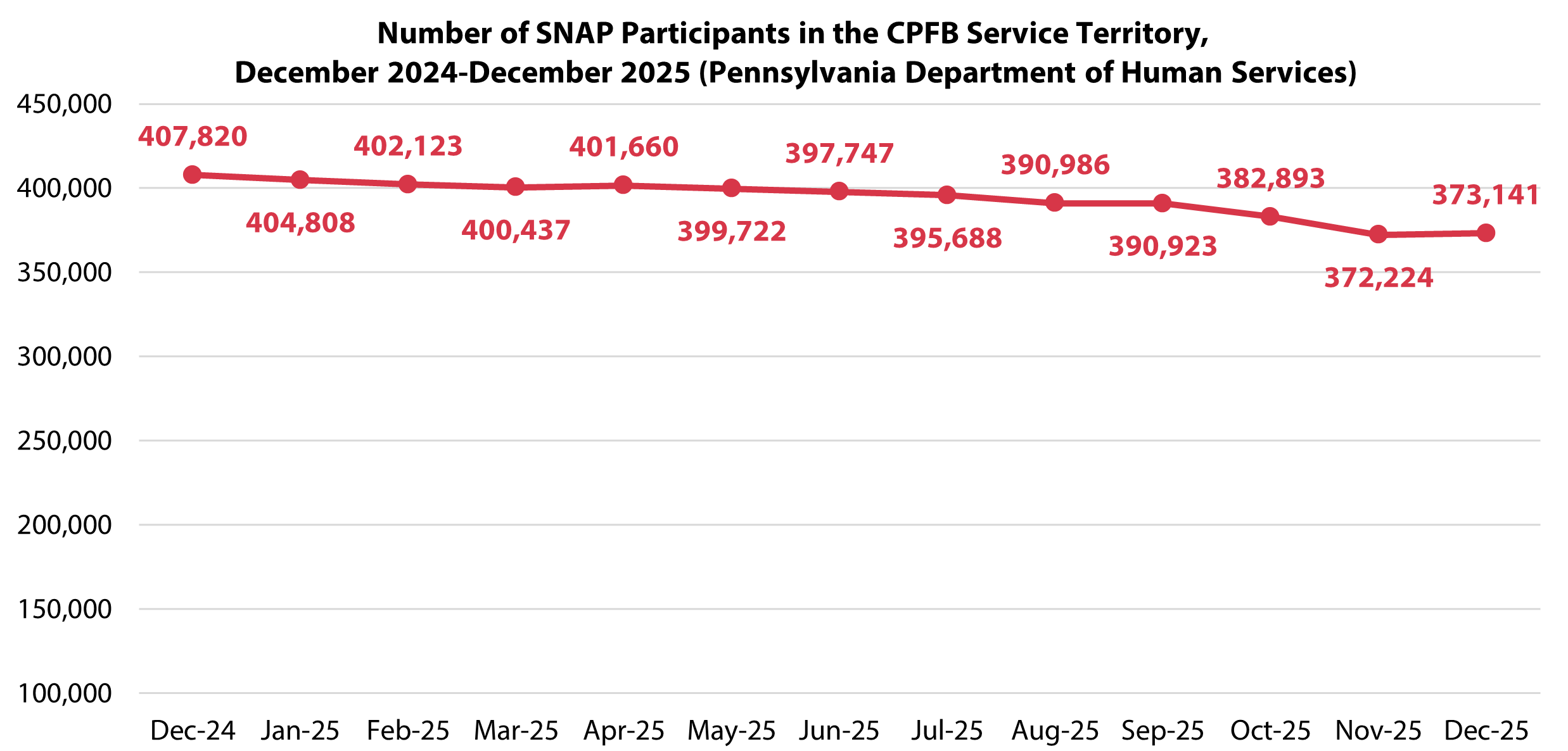
Though there was a downward trend in SNAP participation across the CPFB's service area over the course of the entirety of 2025, it became more pronounced in the summer and fall, likely as enrollees and potential participants heard discussions of SNAP cuts on the news or became more aware of the new work requirement and elected not to renew or apply because they believed they would not qualify or that the application process would be too difficult. In some cases, misinformation may have played a role; CPFB researchers spoke with a neighbor in May 2025 who was under the impression that SNAP was being eliminated entirely based on news he had heard about the federal budget debate underway at the time, showing that it can be difficult for the public to distinguish between what is simply being debated in Congress and what policies are or will be put into effect.
As mentioned previously, it is important to keep in mind that although the work requirements came into force in September and November 2025, their full effect will not begin to be reflected in the data until December 2025 and February 2026, as individuals unable to meet the new work requirements who remained on the program through the three-month time limit begin to drop off. That is, the decrease in participation in late 2025 is likely just an early indicator of a further decrease in participation in the nation's largest and most important nutrition assistance program. However, other factors outside work requirements continue to be important drivers of SNAP participation, as demonstrated by the fact that participation increased slightly in December 2025 even though some work requirements had begun to be binding. The Central Pennsylvania Food Bank is committed to ensuring that all central Pennsylvanians have enough to eat and will continue to offer SNAP outreach and application assistance across our service territory, in addition to partnering with more than one thousand local food pantries and food programs that support our neighbors in need.