
By Morgan Flood, Policy Research Specialist
On December 31, 2025, the United States Department of Agriculture released the Household Food Security in the United States Report for 2024. First published in 1997, the Household Food Security Report provides an annual snapshot of food security and insecurity across the United States using information collected from a special December supplement to the Current Population Survey, a monthly survey conducted by the United States Census Bureau with support from the Bureau of Labor Statistics.
Over the last three decades, the Household Food Security Report and the eighteen-question food security module used in data collection have been regarded as the gold standard measure of food insecurity within the United States; CPFB’s own Community Hunger Mapping projects use a six-question short-form version of the USDA food security battery to help assess the need for charitable food in our local communities and the impact of our partner agencies’ work to alleviate hunger. These tools are the best measures of need in the United States. Since the food security module is a survey of individuals’ experiences, it is less prone to measurement debates than other statistics like the federal poverty line. Food insecurity rates as measured using the USDA food security battery therefore provide a clear picture of how lived economic hardship affects access to food, which is one of the most basic necessities, as well as how hardship changes over time.
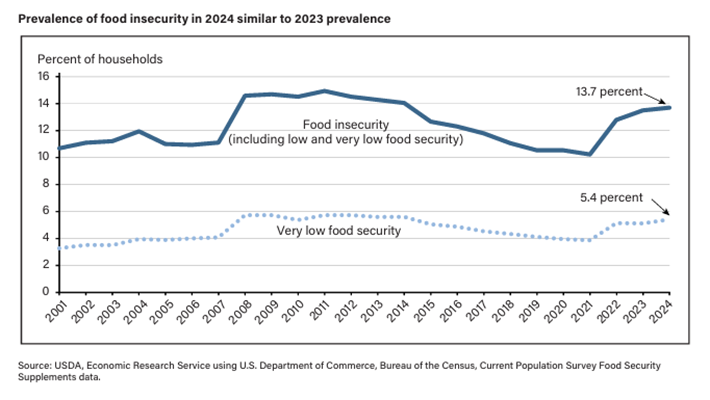
The new report found that about one in seven American households (13.7%) had experienced food insecurity in 2024. One in nineteen households (5.4%) experienced very low food security, the most severe form of food insecurity. Households facing very low food security have actively cut the size of their meals or skipped meals due to a lack of money for food; that is, these households are going hungry on a regular basis.
As shown in the chart below, national-level food insecurity rates in 2024 were similar to those seen in 2023, but both are substantially higher than in 2021 and are nearly as high as food insecurity rates observed during the Great Recession and its aftermath beginning in 2008. Very low food security rates follow the same trend, but at lower levels. This trend is concerning, and it aligns with CPFB internal data from the same time frame that indicates sustained increased demand for charitable food assistance since 2020.
Additionally, as of 2024, USDA found that food insecurity had disparate impacts on Americans based on demographic and household composition as well as geography. About one in five (18.4%) households with children were food insecure in 2024, including almost two in five single-mother households (36.8%) and one in four single-father households (23.8%). Black and Hispanic households saw substantially increased food insecurity rates at 24.4% and 20.2% respectively, compared to 10.1% for non-Hispanic white households. One in three households (32.8%) with incomes below 185% of the federal poverty line, which is also the threshold for government-funded charitable food assistance in Pennsylvania, faced food insecurity in 2024. Americans living in urban centers and rural areas also had elevated food insecurity rates, at 16.0% and 15.9%.
The Household Food Security Report provides critical insight about the food security landscape in the United States and the uneven impact food insecurity can have across communities to food banks and food pantries, government entities and policymakers, anti-hunger and anti-poverty advocates, and many more. However, the 2024 report is the last scheduled report on food insecurity. In the summer of 2025, USDA announced that it would cease to produce the report moving forward. The elimination of future reports means that it will be much more difficult to assess the impact of economic changes, public policy decisions, and private initiatives on experiences of food insecurity across the country. There is no replacement for this report nationally, so going forward, we will have a less clear picture on the food insecurity landscape in the United States. Despite this quickly approaching data gap, the CPFB Impact and Policy Research team will continue to work to understand food insecurity locally and support evidence-based progress toward a central Pennsylvania where no one goes hungry.