The Ongoing Impact of Universal School Breakfast in Pennsylvania
By: Morgan Flood, Policy Research Specialist
By Morgan Flood, Policy Research Specialist
his week is National School Breakfast Week, an annual observance during the first full week of March that celebrates the role school breakfast plays in ensuring students are ready to learn. In this month's policy blog, CPFB Policy Research assesses the impact Pennsylvania's universal school breakfast initiative has had and continues to have on participation across the Commonwealth and within the Food Bank's service area.
Pennsylvania has offered breakfast to all students without requiring their families to submit any paperwork or meet income eligibility standards since October 2022. Since then, the program has continued and expanded to also offer free lunch to about 22,000 students who would only qualify for reduced-price meals under current federal standards.
Statewide, school breakfast participation increased by more than 40% from 2019 to 2025. The average proportion of public-school students who eat breakfast at school has risen from 27.0% in 2019, the last year without universal school breakfast for which comparable data is available, to 38.3% as of 2025. The most rapid increases were seen in the first two years of the initiative, but the fact that participation continues to rise four years into the program shows that the program continues to reach new children.
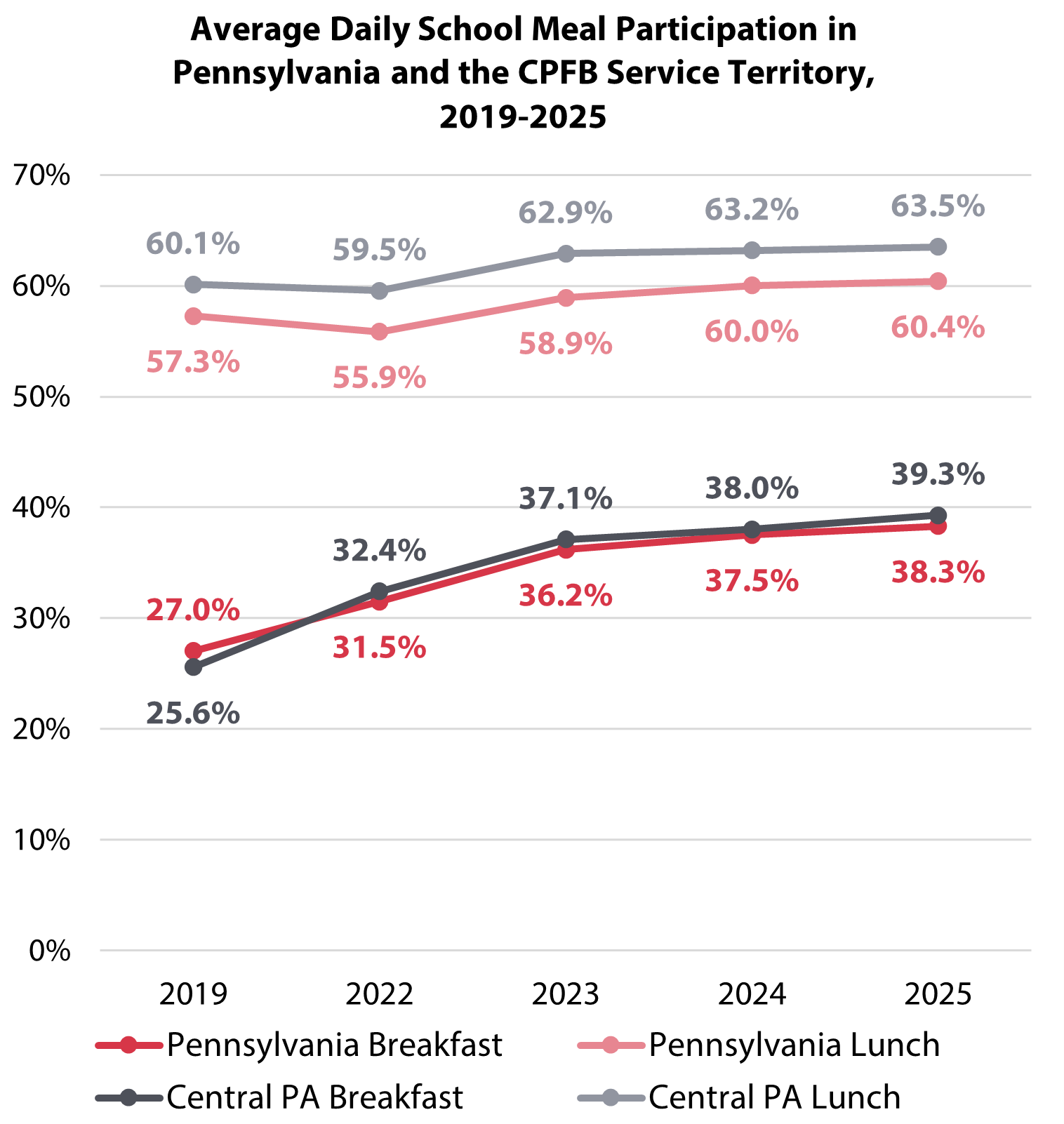
Among public schools in the CPFB's service territory, breakfast participation has grown even faster, rising by more than 50% compared to six years ago. Central Pennsylvania now has a breakfast participation rate of 39.3%. Central Pennsylvania's children were slightly less likely than their peers statewide to eat breakfast at school in 2019, with a 25.6% participation rate, but as of 2025, they were more likely to eat breakfast at school.
Meanwhile, lunch participation grew at a much slower pace, increasing just 5.5% statewide and 5.6% in central Pennsylvania between 2019 and 2025. The divergence in trends between the two school meal programs is highly compelling evidence that the primary driver of the increase in school breakfast participation over the last several years is the universal school breakfast initiative, as school lunch eligibility has not expanded in the same way.
Universal school breakfast has clearly been a highly effective investment in regard to increasing participation, but it will bring long-term benefits above and beyond helping to ensure that no child learns on an empty stomach. Research shows that school breakfast consumption is associated with a variety of positive outcomes, including improved test performance and academic achievement, better attendance and engagement, lower risk of food insecurity, and higher dietary quality. Given the large increase in breakfast participation in Pennsylvania over the last several years, it is reasonable to expect that there will be improvement in these metrics as well, though more research would be needed to properly assess any potential effects.
Beyond this, there remains room for further growth, as students are still about 40% less likely to eat school breakfast than school lunch. Strategies that could help schools capitalize on universal school breakfast include offering alternative service models, such as breakfast in the classroom, second-chance breakfast, and breakfast after the bell, as well as participation in the Governor's School Breakfast Challenge, which encourages and recognizes schools for promoting breakfast, including local food in school meals, and implementing other sustainable changes that can increase participation.
Author's Note: For the purposes of this policy blog, "public school" is defined as a school for which the sponsor of the National School Lunch Program and School Breakfast Program is a school district with a defined geographic catchment area. This means that some public schools, such as charter schools and magnet schools, were excluded if they sponsor the federal meal programs independently, and that some private or alternative schools were included if their NSLP and SBP sponsor is a school food authority associated with a school district. In accordance with methods used by FRAC, October has been used as the base month for year-over-year analysis.