
By Morgan Flood, Policy Research Specialist
On Friday, March 27, CPFB Impact and Policy Research will release their eighth Community Hunger Mapping report. Covering the six northernmost counties of the Food Bank’s service territory – Bradford, Clinton, Lycoming, Potter, Sullivan, and Tioga, which together make up an area slightly larger than Connecticut – the Northern Tier report is the result of a year-long project aimed at understanding the experiences of food insecure neighbors across the region and the local charitable food system’s response to hunger. The full report will make specific recommendations across a variety of topics, all with the goal of helping the Food Bank, its partner agencies, and other stakeholders take action to improve services and make progress toward a north central Pennsylvania where no one goes hungry.
This policy blog previews a major finding from the report: across the six Northern Tier counties, there are sizable gaps in geographic access to food pantries, with large areas lacking a permanent charitable food outlet within a 15-minute drive time. Although many of these areas are fairly lightly populated, others are not. In some cases, especially in much of Bradford County as well as parts of Lycoming and Tioga counties, this potentially leaves sizable numbers of food insecure individuals to drive fairly long distances to get assistance on a regular basis or potentially to go without if travel burdens are too high.
The map below shows the number of food insecure individuals residing in each census tract across the Northern Tier divided by the number of permanent food pantries within a 15-minute drive time of each tract’s center of population. The darker the shade of blue displayed on the map, the more food insecure residents per food pantry. Areas lacking a permanent food pantry (i.e., excluding pop-up and distributions that do not have consistent distribution hours and locations) within a 15-minute drive time are shaded with diagonal lines.
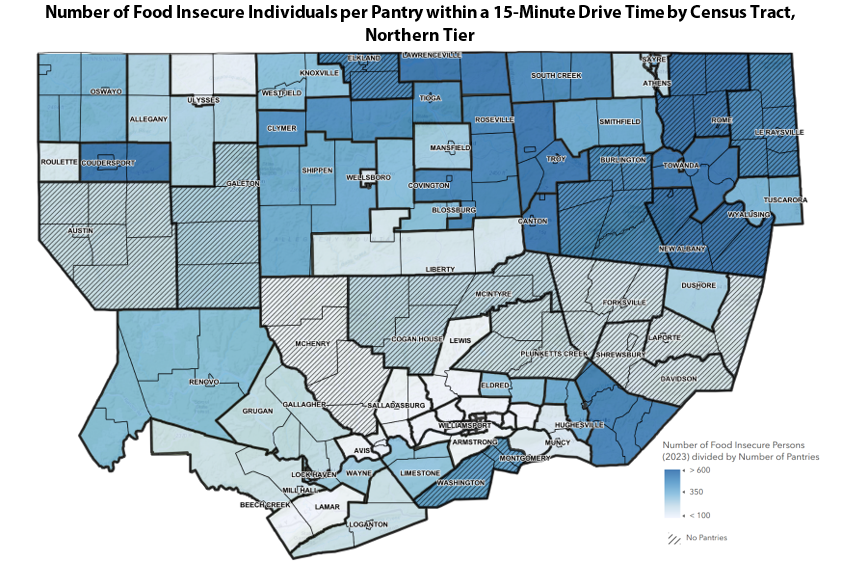
Overall, the results of the analysis show that about nine in ten (88%) food insecure residents of the Northern Tier have access to at least one food pantry within a 15-minute drive time. This is primarily because many of the areas lacking a food pantry within a 15-minute drive time, such as much of northern Lycoming County, southern Potter County, and Sullivan County outside Dushore, are mostly covered by state forests, parks, or gamelands and do not have large food insecure populations; in general, there are fewer than 300 food insecure individuals per census tract in these areas. Given these areas’ remoteness, mobile pantries may be a good solution.
However, there are several census tracts that have 450 or more food insecure individuals without access to a permanent food pantry, including the area around Washington Township in southern Lycoming County; much of southern Bradford County, including New Albany and Burlington; the northeastern corner of Bradford County around Rome and Leraysville; and the Elkland area of Tioga County. Although there are pop-up distributions serving several of these communities, as mentioned previously, they were not included in this analysis because they do not have consistent hours or locations and therefore may not be a reliable source of assistance. In these areas, turning these pop-ups into mobile pantries by adding regularly scheduled hours at stable locations could be an initial step to addressing these gaps.
Beyond this, even in areas where there is a pantry within a reasonable drive time, there remain opportunities to expand access. Just seven in ten food insecure residents of the Northern Tier (68%) have access to two or more nearby pantries, which can mean that in some areas there are large numbers of food insecure individuals may all be reliant on the same pantry. For example, the Canton and Troy areas along the Bradford/Tioga county line have 500 or more food insecure individuals with access to just one pantry. Other areas falling into this category include the southeastern panhandle of Lycoming County east of Hughesville; the Coudersport area of Potter County; and a wide swath of north-central Tioga County stretching from Tioga borough to Clymer Township. Again, mobile pantries with consistent hours at established locations or investigating the possibility of adding new partners to the CPFB agency network may be appropriate in these areas.
On the whole, it is clear that opportunities to widen the distribution of food pantries across the Northern Tier exist and that the charitable food system should assess the tools available to address these gaps, especially since geographic gaps may be upstream of other gaps in service, such as lack of access to client-choice pantries or pantries offering evening and weekend hours. The full report and launch event will feature a wide variety of analysis and recommendations around this and other topics that will help the Food Bank, our partner agencies, and other anti-hunger and anti-poverty organizations expand access to assistance and act against hunger across the Northern Tier.
To learn more, please join our launch event, which will be held on Friday, March 27 in the Jane Shultz Room of the Wertz Student Center at Lycoming College in Williamsport. To attend the launch in person, which will begin at 11:45AM and include a networking lunch, a meeting of the North Central Pennsylvania Coalition Against Hunger, and a nutrition education session in honor of National Nutrition Month, please register here. We also welcome those who are unable to come in person to join us virtually via Zoom.