Eviction, Foreclosure, and Forced Moves Among Central Pennsylvania Food Pantry Visitors
By: Morgan Flood, Policy Research Specialist
By Morgan Flood, Policy Research Specialist
Housing instability is strongly associated with food insecurity. Because housing is the largest single expense for most households, those with low incomes and limited resources are often forced to choose between paying their rent or mortgage and purchasing groceries. Many will choose to cut back on food to stay housed, as individuals have more flexibility around their food expenditures than their housing costs – thus the saying ‘the rent eats first.’ A recent study found that food insecurity and housing instability have a bidirectional relationship, meaning that experiences of housing hardship can directly drive food hardship and vice versa. In this policy blog, CPFB Impact and Policy Research (IPR) uses the results of neighbor surveys to analyze the relationship between experiences of or worries about forced moves and food security status as measured by the six-question short-form USDA food security module among central Pennsylvanian food pantry visitors.
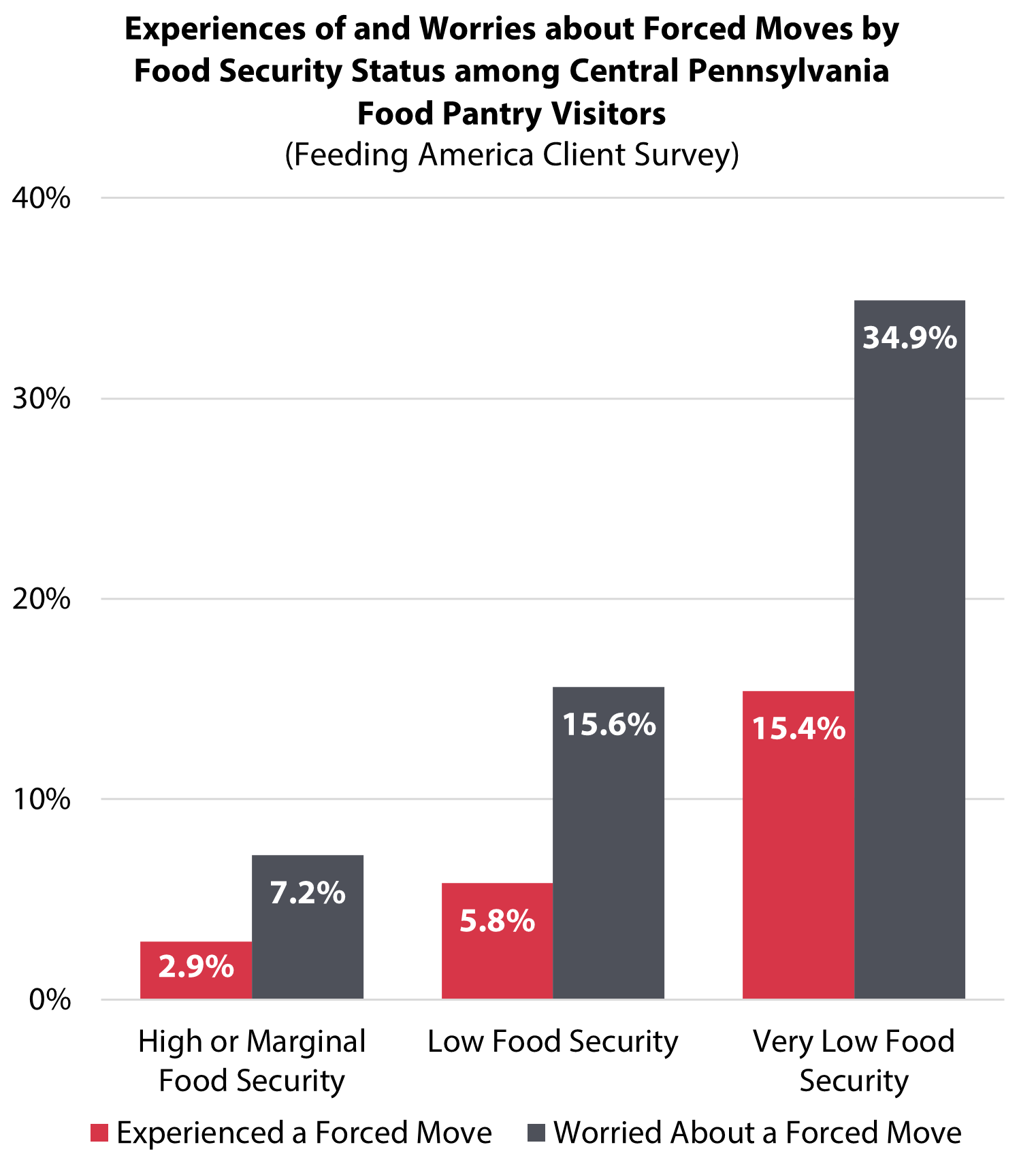
As shown in the chart at left, experiences of and worries about forced moves (i.e. eviction or foreclosure) are much more common among pantry visitors who face more severe food insecurity. Neighbors who experienced very low food security were about five times as likely to have experienced a forced move within the last year as those in the high or marginal food security category, with a forced move rate of 15.4% compared to 2.9%. Very low food security is the most severe form of food insecurity and is characterized by skipping or cutting the size of meals due to lack of funds to purchase food.
That is, one in six central Pennsylvanian households who reported experiencing hunger even while accessing the charitable food system had also gone through an eviction, foreclosure, or other involuntary move in the year prior to being surveyed, while only about one in thirty pantry visitors who were relatively food secure had faced a forced move in that time frame.
Neighbors experiencing low food security, a less severe form of food insecurity characterized by anxiety about food accessibility and a reduction in the variety of food consumed due to financial constraints, fell in the middle, with a forced move rate of 5.8%, or about one in seventeen; this rate was about a third of that seen among households experiencing very low food security, but still twice that of households in the high or marginal food security category.
Comparable trends applied to concerns about forced moves, but at a higher rate. More than one in three pantry visitor households experiencing very low food security (34.9%) were worried that they would go through an eviction, foreclosure, or other move in the coming year, compared to about one in six households falling in the low food security category (15.6%) and about one in fourteen (7.2%) households in the high or marginal food security category.
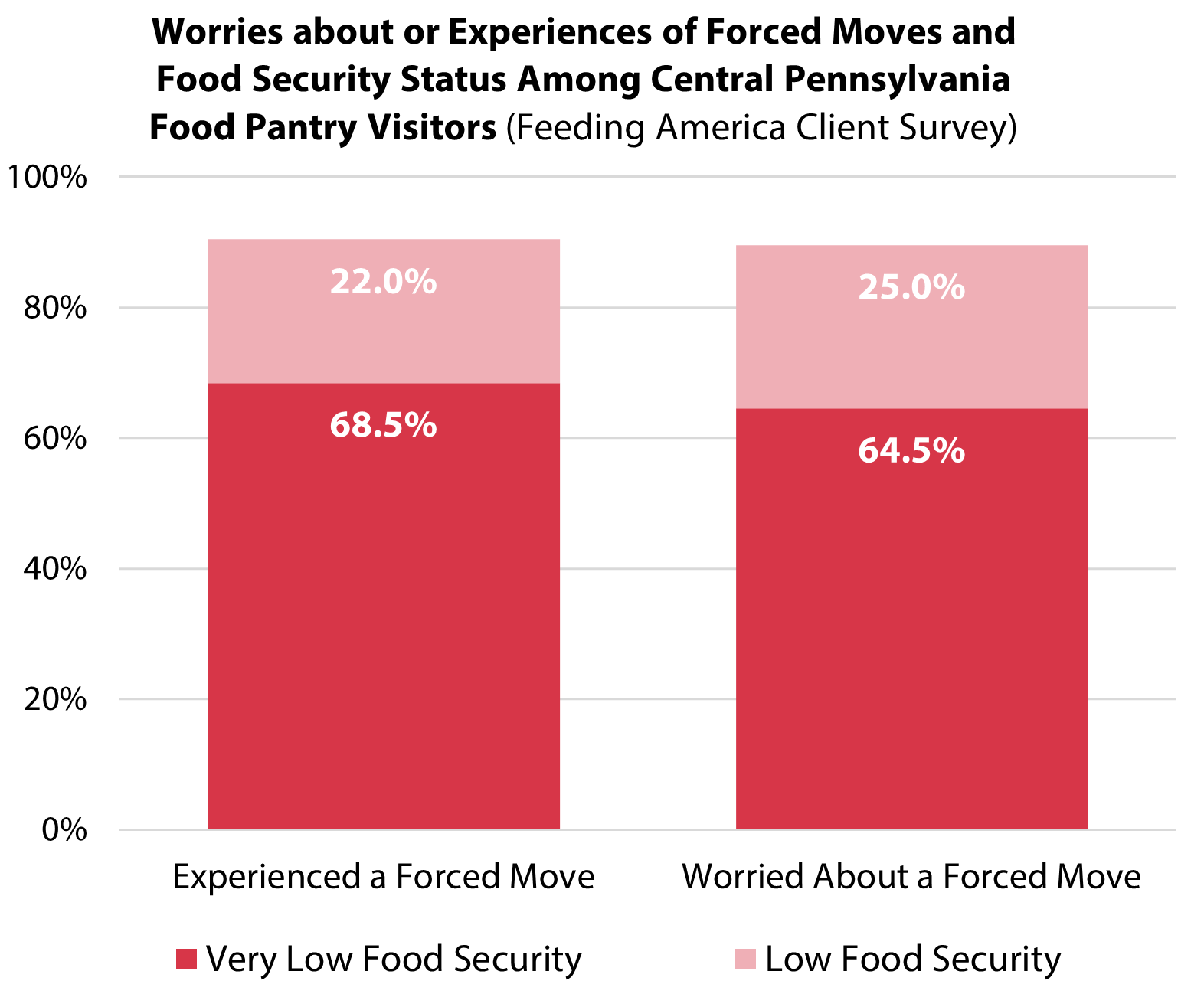
The strong association between food security and housing security is further demonstrated by the fact that almost seven in ten pantry visitor households who reported going through a forced move in the last year (68.5%) were also facing very low food security. Another one in five households who had moved involuntarily (22.0%) fell into the low food security category, meaning that nearly all households who had experienced an eviction, foreclosure, or other involuntary move were also food insecure, even though they were accessing the charitable food system. Proportions were similar among those who worried about forced moves, with just under two thirds experiencing very low food security (64.5%) and another quarter (25.0%) facing low food security.
Overall, these findings align with existing academic literature on the intersections between housing stability and food security. As mentioned in previous posts on this blog, the charitable food system should be cognizant of the fact that many of the neighbors they serve are likely handling challenges related to housing as well as food, or may have gone through difficult housing situations in the past. For this reason among others, pantries should consider providing trauma-informed care training to staff and volunteers, as research shows that the threat or experience of eviction and other forced moves can cause lasting mental and physical health difficulties. Resources and trainings developed by Leah’s Pantry are specifically tailored for the charitable food system and could be a good starting point. Additionally, pantries and other service providers can take action to support households in precarious housing situations by offering warm referrals to housing-related resources, including rental assistance programs, legal aid, and eviction prevention services, or by offering some of these services on-site if capacity allows.
Data Sources and Methods:
The key data collection tool used as part of IPR’s flagship Community Hunger Mapping research initiative is the Feeding America Client Survey (FACS), a survey conducted at food pantries that asks visitors about their experiences with charitable food, demographics, and personal circumstances, including their food security status and housing situation. Since surveying began in fall 2022, more than 3,700 households visiting more than 70 agencies across sixteen counties have responded to the survey. Adams, Bradford, Centre, Clinton, Cumberland, Dauphin, Franklin, Lancaster, Lebanon, Lycoming, Northumberland, Potter, Snyder, Sullivan, Tioga, and Union counties are the sixteen represented counties; they are geographically diverse and together make up more than two thirds (68.7%) of the total population of CPFB’s service area, so the aggregate data can be assumed to be generally representative of food pantry visitors across central Pennsylvania.