By Morgan Flood, Policy Research Specialist
Although the internet seems ubiquitous, not everyone has access to it. According to Pew Research Center, nine in ten American adults had a smartphone, and eight in ten had home broadband internet as of 2023, but there were disparities based on demographic factors, such as age, education, income, race or ethnicity, and place. Lack of internet access can be a major barrier for many rural or low-income individuals and households, including food pantry visitors. Internet access enables full participation in the economy and society through online educational opportunities, medical appointment scheduling, online applications for benefits like SNAP and Medicaid, job searching and working, shopping, and much more. In this policy blog, CPFB Impact and Policy Research (IPR) assesses internet access among central Pennsylvanian food pantry visitors compared to the overall population as measured by the results of pantry surveys and the 2023 5-Year American Community Survey (ACS) conducted by the United States Census Bureau.
As part of its flagship Community Hunger Mapping Initiative, IPR conducts surveys with food pantry visitors that ask a variety of questions about their personal circumstances, experiences at pantries, and much more, including if the pantry visitor has access to home internet, mobile data, both, or neither. Nearly 3,500 surveys have been conducted across 67 agencies in fifteen different counties since data collection began in fall 2022. The fifteen included counties are Adams, Bradford, Clinton, Cumberland, Dauphin, Franklin, Lancaster, Lebanon, Lycoming, Northumberland, Potter, Snyder, Sullivan, Tioga, and Union. Together, these counties account for more than 60% of the population of CPFB’s service territory, and they are geographically diverse, meaning that the survey results are reasonably representative of the entire CPFB service territory.
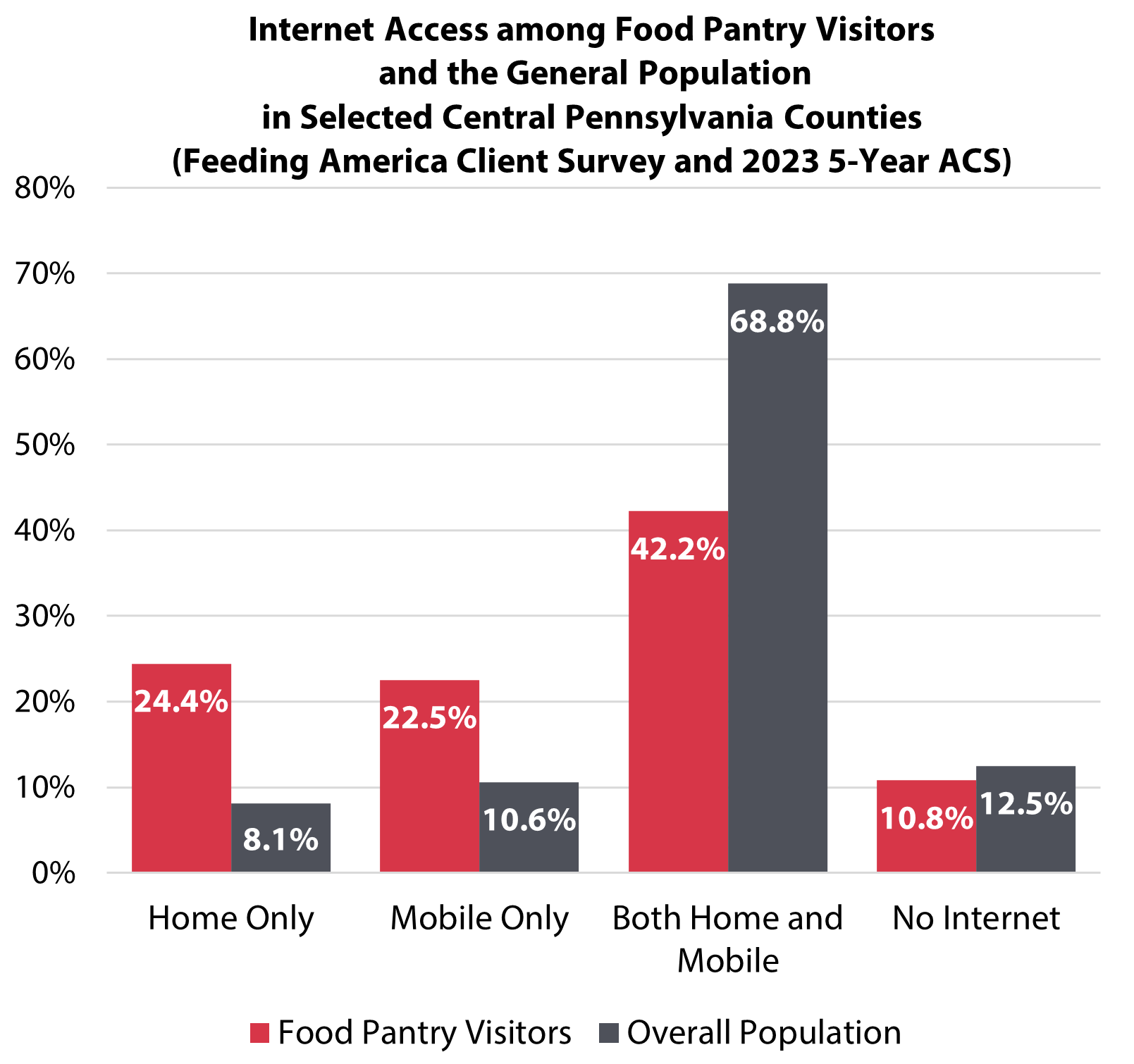
Overall, nearly nine in ten (89.2%) pantry visitor households in counties where surveys had been completed had access to the internet via either a home connection or a mobile phone, which was slightly higher than the 87.5% rate among the broader population in the same counties according to the 2023 ACS. However, this broadly similar overall rate masks differences in the type of internet access available to pantry visitors compared to the general population.
As shown in the chart at right (below on mobile), food pantry visitors were substantially more likely than the overall population to have just one connection to the internet. A quarter (24.4%) of food pantry visitors reported having only home internet access, compared to one in eleven households overall. Similarly, just over a fifth (22.5%) of pantry visitor households had only a mobile connection to the internet compared to about one in nine (10.6%) of all households. In total, almost 70% of all households had both home and mobile internet access, but only two in five food pantry visitor households said the same. This disparity is likely the result of pantry visitor households, who are almost universally at or below 185% of the federal poverty level, needing to prioritize one type of connection over the other due to tight budgets.
As part of its efforts to alleviate upstream and intersecting issues with hunger and in light of these findings, the charitable food network should be cognizant that many of the neighbors it serves may lack or have limited connectivity. There are a number of initiatives that offer support with internet costs or discounted internet services to low-income individuals and families, such as Lifeline and programs operated by internet service providers themselves. Pantries should be aware of these resources and provide information about them to interested visitors if possible. The charitable food network makes connections with our neighbors every day as it works to help them meet their basic needs; it can help them get connected to the internet, too.